
Debt Management
In alignment with other provinces, the Government of Prince Edward Island (GPEI) uses debt to:
- Invest in long-term infrastructure that supports economic growth
- Manage year-to-year cash flow needs
- Respond to unexpected fiscal pressures such as economic downturns or emergencies
- Support Crown Corporations that deliver public services
The provincial debt management strategy ensures Government stays financially stable now and in the future. The strategic objective is to borrow responsibly, keep costs low and reduce financial risks over time, while ensuring the Province can access financial markets to raise capital when needed.
Debt Overview
Debt is incurred when total operating and capital expenditures exceed total revenues. Government borrows money from investors and, in return, pays those investors interest until the original amount borrowed is repaid at maturity.
PEI’s debt includes:
- General government borrowing
- Crown corporation debt guaranteed by the Province
- Short-term borrowing for cash and liquidity management
Government follows a disciplined approach to debt management that includes:
- Maintaining diversified borrowing sources
- Managing interest rate and refinancing risks
- Ensuring liquidity through short-term borrowing programs
- Aligning borrowing with capital plans and fiscal forecasts
Transparency
The GPEI provides regular updates on its financial position and activities through:
- Annual Public Accounts
- Operating and Capital budget estimates documents
- Fiscal and economic updates
- Report on borrowing tabled within the first 15 days of each legislative sitting
- Orders in Council issued to notify the public when long-term borrowing has happened in accordance with Loan Acts approved by the Legislative Assembly of PEI.
These reports include detailed information on debt levels, borrowing activities, and fiscal projections, ensuring accountability to Islanders.
The total increase in net debt since 2021/22 is due to capital spending. Capital assets are expected to last a long time and benefit both present and future Island residents. Therefore, the cost is spread over the life of the assets and shared by all those who will benefit from them during the asset's projected lifespan.
Debt Issuance Programs
GPEI meets its annual borrowing requirements primarily through established domestic borrowing programs. Government raises funds in the Canadian capital markets by issuing bonds and short-term treasury notes.
Domestic programs
Domestic Long-Term Borrowing Program
GPEI’s primary source of external funding is its domestic long-term borrowing program. Under this program, the Province issues Canadian-dollar debentures in Canadian capital markets, generally with medium- to long-term maturities (often in the 5 to 30-year range), to finance capital spending and operating requirements. These debentures are then traded in the secondary market.
Borrowing decisions are evaluated against the domestic market benchmark to ensure the most cost-effective funding.
Debentures issued under GPEI’s domestic long-term borrowing program are:
- Denominated in Canadian dollars and issued in the domestic Canadian capital market;
- Issued in fully registered, book-entry (non-bearer) form through CDS Clearing and Depository Services Inc.;
- Settled through CDS Clearing and Depository Services Inc.;
- Issued under the authority of the Province of Prince Edward Island’s Financial Administration Act, Annual Loan Acts and related provincial legislation.
Canadian Short-Term Borrowing Program
Government meets its short-term funding and cash-flow requirements through the issuance of Canadian-dollar Treasury Notes.
These Treasury Notes are typically issued with maturities of one year or less and are used to manage cash flow needs, refinance maturing short-term obligations, and provide flexibility in GPEI’s overall borrowing strategy. Issuance normally occurs on a weekly basis in the domestic money market, with financial institutions assisting in distribution to institutional investors active in the short-term debt sector.
Treasury Notes issued under the Government’s short-term borrowing program are:
- Issued in Canadian dollars in fully registered, book-entry (non-bearer) form
- Cleared and settled through CDS Clearing and Depository Services Inc.
- Authorized under the Province of Prince Edward Island’s Financial Administration Act
The Approach
The debt management approach is guided by the principles of transparency, prudence, and liquidity, and focuses on a general sinking fund and two formal fiscal anchors. It enables keeping debt under control by setting clear financial targets (anchors) to inform budget planning, provide structured debt repayment and reduce refinancing risk.
Sinking Funds
A sinking fund is a savings account to pay off specific future debt when it comes due. There are two categories of sinking funds: bond-specific sinking funds, and general debt repayment fund.
By gradually accumulating and investing reserve funds for future debt retirement, GPEI reduces the financial burden when the liability comes due and avoids continual reliance on short-term borrowing at potentially higher cost.
Bond Specific Sinking Funds
Bond specific sinking funds are typically set up as separate accounts or reserves dedicated to a specific long-term obligation.
Contributions (or installment payments) are made regularly, often annually, from the operating fund. Contribution schedules are planned in advance to ensure the sinking fund reaches required levels by the time obligations mature.
As of March 31, 2025, GPEI currently has $358 million in sinking fund assets that will be used to pay down eight future maturing debt obligations.
General Debt Repayment Funds
In December 2025, GPEI approved the establishment of a general sinking fund to strengthen its long-term debt management by ensuring dedicated, disciplined savings are set aside to meet future refinancing and repayment needs. This fund is intended to reduce refinancing risk, support structured debt repayment, and help Government remain within its fiscal anchor targets.
By building a flexible, non-bond-specific reserve, Government will enhance its ability to manage upcoming maturities, lower long-term borrowing costs, and improve resilience against market, interest rate, and liquidity risks. The sinking fund also reinforces prudent financial planning by ensuring resources are accumulated over time, rather than relying on short-term borrowing or exposure to volatile capital markets at the time debt comes due.
Funding sources will include a minimum $2 million annual contribution, at least 50% of future operational surpluses, 25% of net income interest from the liquidity reserve and short-term borrowing program, and/or a portion of unexpected windfalls at Treasury Board’s discretion.
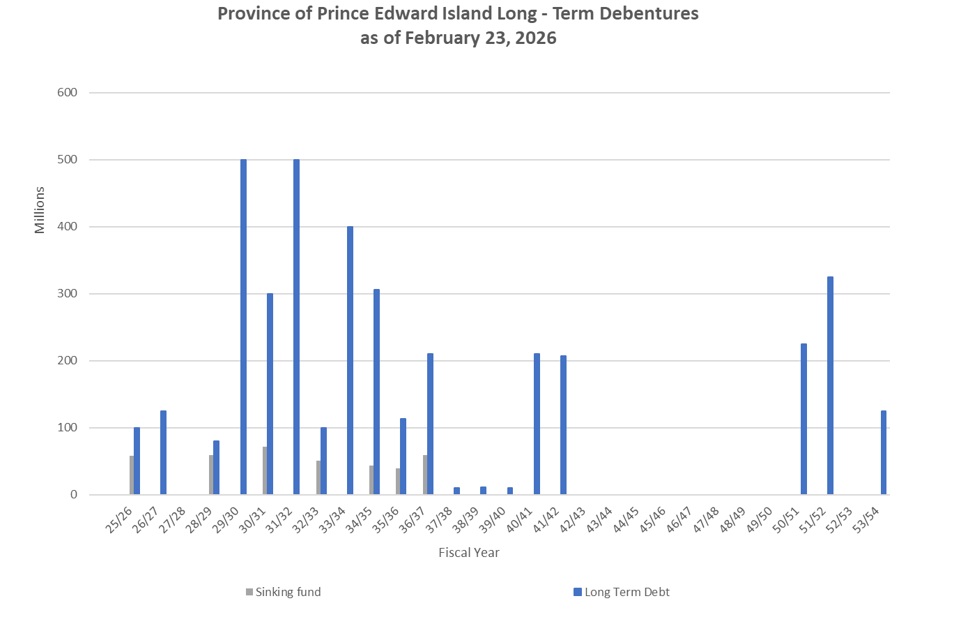
This graph indicates current sinking fund totals that will be used to pay off projected net debt and will be updated periodically as sinking fund investments are made.
Fiscal Anchors
Net Debt-to-GDP Ratio (<40%)
A measure of total debt relative to its economic output. A lower ratio indicates the province’s GDP growth is adequate to meet its debt obligations without needing to continuously increase debt levels.
In December 2025, GPEI formally targeted a Net Debt/GDP ratio below 40%. As of December 2025, it is 32.9%
Interest-to-Revenue Ratio (<7.5%)
A measure of how much revenue is consumed by debt servicing.
In December 2025, GPEI formally targeted keeping interest payments below 7.5% of revenue to preserve fiscal flexibility and avoid crowding out essential services. As of December 2025, it is 5.2%
Investor Relations
PEI undertakes investor relations activities to support its borrowing programs and ensure it can access capital at the lowest possible cost. By sharing up‑to‑date economic, fiscal, and financing information with investors, Government helps maintain transparency, broaden and diversify its investor base, and demonstrate prudent financial management.
Investor relations activities allow GPEI to engage with investors to discuss economic conditions, market developments, and funding strategies—helping the province sustain strong market presence and stable access to financing needed for public services and infrastructure. Department of Finance staff regularly presents at investor relations conferences, intergovernmental exchanges, and other investor-related activities.
Credit Ratings
Credit ratings are an indication of a borrower’s ability to pay interest and to repay the principal balance, upon maturity, of its outstanding debt.
A traditionally strong economy and good fiscal anchors have ensured PEI has remained well received by investors, which has helped minimize financing costs for government. Examples of institutional investors who invest in PEI bonds include pension funds and insurance companies.
Currently, PEI is long-term rated by the following agencies:
- Moody's: Aa2 with a stable outlook.
- Morningstar DBRS: A with a stable outlook.
- Standard & Poor's: A with a stable outlook.
Risk Committee
GPEI is establishing a Risk Committee - a senior management committee that will be comprised of:
- The Deputy Minister of Finance, Committee Chair
- Four non-government affiliated finance professionals
- Director of Pensions and Capital Management
- Director of Economics, Statistics and Federal Fiscal Relations
Ex-officio participants in the Committee will include:
- Secretary to Treasury Board
- Comptroller
The non-affiliated professionals will be individuals with significant experience and expertise in capital markets, financing, and economics.
The Committee will act as a senior advisor with respect to the Province's liability management, policies, and activities, and will meet regularly. The purpose of the Committee is to make recommendations and/or provide financial advice to the Deputy Minister of Finance regarding the financial risks of the province as they relate to the management of its liability portfolios, and including, but not limited to:
- The annual borrowing strategy
- Risk management parameters of the debt portfolio
Risk Management
GPEI actively manages debts due dates so they can be paid off in an orderly way, without taking on unnecessary financial or market risk. This helps keep borrowing costs stable and as low as possible. In recent years, Government has made strong progress in retiring older, higher‑cost debt.
GPEI continuously monitors such potential risks as:
- Economic Risks
- Fiscal and Revenue Risks
- Demographic Risks
- Market and Borrowing Risks
To mitigate these risks, Government continues to target lower Debt to GDP and Interest to Revenue ratios, to support economic growth in the province, engage proactively with rating agencies and investors, and focus on capital investments that yield long-term economic returns.
Disclaimer
This page is intended for information purposes only.