
Race and Ethnicity Data Collection Project
Race and Ethnicity Data Collection Project
- What’s Happening?
- How to Join Community Information Sessions
Frequently Asked Questions (FAQs)
Where can I find more information?
About the Project
The Prince Edward Island Department of Health and Wellness, in partnership with Health PEI and the Canadian Partnership Against Cancer, has initiated a new project called the Race and Ethnicity Data Collection Project.
This project will voluntarily collect information about race and ethnicity when you apply for or renew your PEI Health Card, starting April 1, 2026.
Why This Project Matters?
As shown in the figure below, Prince Edward Island has experienced significant population growth over the past 5 years, reaching approximately 154,480 residents according to the 2021 Census data from Statistics Canada.
Racialized and ethnically diverse residents - those who identify as a member of a racialized group or Indigenous - make up about 11.6% of the population (approximately 9.5% racialized group members plus 2.1% Indigenous Peoples). The figure below illustrates this growth trend among racialized non-Indigenous groups:
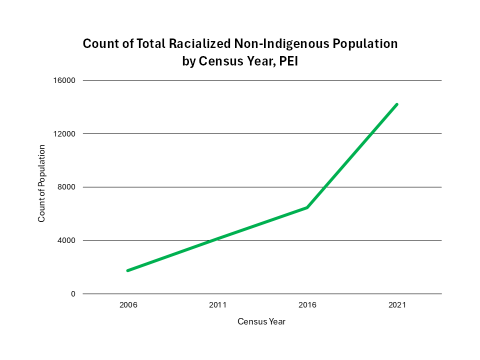
Data Source: Statistics Canada 2021 Census
Engaging Black, Indigenous, People of Colour (BIPOC), racially, and ethnically diverse communities in PEI is essential because this growing segment represents a significant and diverse portion of the population.
Collecting race and ethnicity data in a community centered and informed approach way will help the province:
- See Differences: Data shows where health services are not working the same for everyone.
- Design Programs: Information helps create tailored health programs and services that meet diverse community needs.
- Track Progress: Credible information ensures accountability towards fair and inclusive healthcare access and delivery for all residents.
- Protect Privacy: Co-create race-based data standards and policies and a data governance framework that complement existing provincial personal information privacy policies and legislation and ensure secure collection, storage, and use of race and ethnicity data in compliance with legal and ethical standards.
Community Engagement
The Department of Health and Wellness has contracted an independent consultant to facilitate community public information sessions for this project.
These community sessions will take place during January and February 2026 and will gather input from BIPOC, and racially and ethnically diverse residents of Prince Edward Island on how race and ethnicity data should be collected, stored, and used. Your feedback will help shape this initiative and ensure it addresses community needs and concerns.
Engagement materials and language of communication will be in English, with one French language session available, as noted below.
What’s happening?
Community Information Sessions/Meetings
As noted below, three Community Information Sessions are scheduled across the province in addition to smaller group discussions with Indigenous communities, BIPOC, racially, and ethnically diverse residents in the province. The community meetings will be held in-person at accessible locations in Charlottetown, Summerside, and Montague. In addition, a virtual Community Information Session will be held. The schedule is provided below. Advance registration is requested:
Community Information Sessions:
- Prince County (Summerside) – In Person
- Tuesday, February 17, 2026 - Credit Union Place, Summerside, 6:00PM – 8:15PM (PEI Time)
- Kings County (Montague) – In Person
- Wednesday, February 18, Rodd Brudenell Resort, 6:00PM – 8:15PM (PEI Time)
- Queens County (Charlottetown) – In Person
- Tuesday, February 24, 2026 – Rodd Charlottetown Hotel, 6:00PM – 8:15PM (PEI Time)
- Community Information Session (Province‑wide) - Virtual
- Wednesday, February 25, 6:00PM – 8:15PM (PEI Time)
Small Focus Group Discussions:
- Native Council of PEI - In Person
- Friday, February 6, NCPEI Office, 6 FJ McAulay Court (NCPEI Charlottetown office Boardroom) 6:00PM - 8:15PM (PEI Time)
- BIPOC Youth/Post‑secondary Resident Information Session - Virtual
- Wednesday, February 11, 6:00PM – 8:15PM (PEI Time)
- French BIPOC Community Information Session - Virtual (French)
- Thursday, February 12, 6:00PM – 8:15PM (PEI Time)
How to Join Community Information Sessions
Advance registration is requested for in-person and virtual community information sessions.
Online Survey
If you wish to provide feedback but cannot attend the scheduled community meetings, we invite you to complete the following survey. This survey will remain open for 3 weeks, starting February 9, 2026, and closing at the end of day February 27, 2026.
Link for survey will be available on February 9, 2026
Frequently Asked Questions (FAQs)
Why is Health PEI asking me to identify my race on the health card application or renewal?
To help make health care fair for everyone. This information will be used to better understand differences in health outcomes, identify gaps in care, and improve services.
What are the options for me to identify my race when I apply?
One question, adapted from the Canadian Institute for Health Information’s (CIHI) Standards for Race-Based and Indigenous Identity (see page 9, also provided below), will be added to the PEI Health Card Application or Renewal Forms. Residents will voluntarily self-identify by choosing all race categories that apply to them from the provided list. There will also be an option “Prefer not to answer” for residents who do not wish to disclose this information.
In our society, people are often described by their race or racial background. These are not based in science, but our race may influence the way we are treated by individuals and institutions, and this may affect our health. Which category(ies) best describes you? Check all that apply.
| Response category | Examples |
| Black | African, African Canadian, Afro‑Caribbean descent |
| East Asian | Chinese, Japanese, Korean, Taiwanese descent |
| Indigenous | First Nations, Métis, Inuk/Inuit descent |
| Latin American | Hispanic or Latin American descent |
| Middle Eastern | Arab, Persian, West Asian descent e.g., Afghan, Egyptian, Iranian, Kurdish, Lebanese, Turkish) |
| South Asian | South Asian descent (e.g., Bangladeshi, Indian, Indo-Caribbean, Pakistani, Sri Lankan) |
| Southeast Asian | Cambodian, Filipino, Indonesian, Thai, Vietnamese, or other Southeast Asian descent |
| White | European descent |
| Another race category; Optional – please specify | Includes values not described above |
| Do not know | Do not know |
| Prefer not to answer | Prefer not to answer |
What is the difference between data collected by Statistics Canada and the race-based question being adapted from CIHI?
Statistics Canada collects race and ethnicity data primarily through national censuses and surveys, using categories focused on population demographics and cultural identity. The race-based data standard from CIHI that is being adapted for this project aligns with standards developed by Statistics Canada for key surveys and resources. The ability to map the response categories of the race-based question to Statistics Canada’s population group standards will facilitate comparison with national data sources, such as the census.
Will Indigenous identity selection(s) be on the health card application and renewal?
Yes. One of the response category options is “Indigenous (First Nations, Inuk/Inuit, Métis).”
Will my race information appear on my physical health card?
No. Your health card will not show your race information.
Will my health care provider have access to my race information?
No. Your race-based response will not be added to your medical record/chart (paper and/or electronic), so cannot be viewed by your health care provider. The race data will be used at the population level for health planning and quality improvement, not for individual care.
How will the race data be used?
To improve healthcare programs and services, identify gaps in care, reduce health disparities, and track progress toward health equity.
Is this a mandatory question on the health card application or renewal form?
No. It is optional. You can choose “Prefer not to answer.”
How will my response be protected?
Your data is protected by law, Freedom of Information and Protection of Privacy (FOIPP) Act, stored securely within Health PEI, and used only for approved health planning and quality improvement purposes.
Where can I find more information?
Contact by Email: redatacollection@ihis.org